
- Home
- Electricity consumer
- Residual mix
Residual mix
The residual mix represents the origin of the electricity for which the origin of the electricity is not proven by cancellation of guarantees of origin.
For electricity consumers
The origin of the electricity consumed is proven by the use of a guarantees of origin.
Guarantees of origin for renewable energy can be obtained together with electricity, i.e. by choosing a suitable so-called green electricity package from an electricity supplier. Another option is to procure them separately from electricity, i.e. procure so-called conventional grid electricity and, subsequently, obtain the required number of guarantees of origin to prove the origin of electricity.
If guarantees of origin have not been used, the origin of electricity is Estonian residual mix.
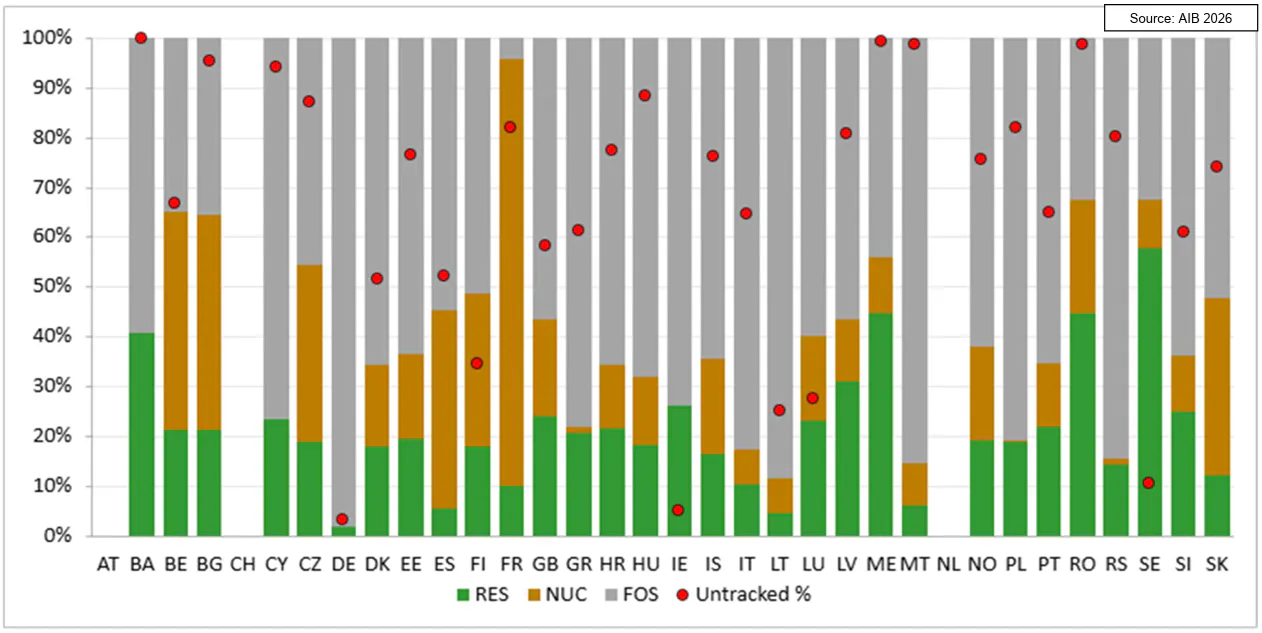
In 2025, the share of electricity consumption not covered by guarantees of origin is 76,35%.
The Estonian residual mix for 2025 was as follows:
19,39% electricity generated from renewable energy sources (including biomass 1,82%, solar 12,33%, wind 2,58%, hydro 2,62 and other RES 0,04%);
63,48% electricity generated from fossil fuels;
17,13% nuclear energy.
The CO₂ intensity of the Estonian residual mix in 2025 is 467,35 gCO₂/kWh and the radioactive waste content is 0,53 mg/kWh.
The Estonian residual mix for 2026 will be published no later than 30 June 2027.
The residual mix results for the years 2019–2025 in table format can be found here:
| Year | Renewable (RES) | Fossil (FOS) | Nuclear (NUC) | CO₂ (g/kWh) | Radioactive waste (mg/kWh) | Share of electricity not proven by GO |
| 2019 | 1,48% | 81,79% | 16,73% | 757,71 | 0,51 | 95,09% |
| 2020 | 6,60% | 69,47% | 23,93% | 548,59 | 0,88 | 85,91% |
| 2021 | 7,55% | 76,37% | 16,08% | 636,58 | 0,65 | 85,14% |
| 2022 | 7,22% | 83,11% | 9,67% | 715,18 | 0,36 | 84,10% |
| 2023 | 6,16% | 87,13% | 6,71% | 711,66 | 0,23 | 79,11% |
| 2024 | 11,55% | 75,69% | 12,76% | 611,96 | 0,38 | 80,21% |
| 2025 | 19,39% | 63,48% | 17,13% | 467,35 | 0,53 | 76,35% |
Background
The guarantee of origin (GO) system enables consumers to choose the origin of the electricity they consume and where it is produced. Matters related to guarantees of origin are regulated by Directive (EU) 2018/2001 of the European Parliament and of the Council, the so-called Renewable Energy Directive (RED).
Guarantees of origin make it possible to reliably track the origin of electricity from production to consumption within the international and complex electricity market.
Directive (EU) 2019/944 of the European Parliament and of the Council on common rules for the internal market for electricity imposes an obligation on electricity suppliers to clearly and comparably disclose at a national level the share of each energy source in the fuel mix used to generate the electricity included in the supplier’s portfolio during the previous year, either on customer bills or in promotional materials made available to final customers.
Pursuant to subsection 3210 (9) of the Energy Sector Organisation Act, the system operator is obligated to develop a methodology for calculating the residual mix and publish the residual mix calculated for the previous calendar year by 30 June.
The residual mix represents the quantity of the electricity for which the the origin is not proven to customers by guarantees of origin. In Estonia, only guarantees of origin issued in Estonia or issued in a contracting state of the European Economic Area and imported to Estonian registry may be used to verify electricity consumption. For the purpose of verifying consumption, the guarantee of origin is marked as cancelled.
The national residual mix allows for the calculation of the origin of electricity supplied by electricity suppliers but not covered by guarantees of origin and makes the data provided comparable.
Since June 2020, Estonia’s official residual mix has been a residual mix calculated and approved on the order of the AIB (Association of Issuing Bodies, of which Elering has been a full member since 2014). More information about the methodology and calculation process used is available on the AIB website. The following graph shows the content of Estonia’s residual mix in comparison with other European countries. Source: AIB
Manused
Estonia’s 2025 residual mix and methodology (in Estonian)
1.1MB | PDF | 19.6.2026
The European overall residual mix and the country-specific residual mixes for 2025, calculated under the mandate of AIB.
12.3MB | PDF | 19.6.2026
Estonia’s 2024 residual mix and methodology (in Estonian)
1.1MB | PDF |
The European overall residual mix and the country-specific residual mixes for 2024, calculated under the mandate of AIB.
988KB | PDF |
Estonia’s 2023 residual mix and methodology (in Estonian)
1.1MB | PDF |
The European overall residual mix and the country-specific residual mixes for 2023, calculated under the mandate of AIB.
1.1MB | PDF |
Estonia’s 2022 residual mix and methodology (in Estonian)
1.1MB | PDF |
The European overall residual mix and the country-specific residual mixes for 2022, calculated under the mandate of AIB.
2.5MB | PDF |
Estonia’s 2021 residual mix and methodology (in Estonian)
1.1MB | PDF |
The European overall residual mix and the country-specific residual mixes for 2021, calculated under the mandate of AIB.
808KB | PDF |
Estonia’s 2020 residual mix and methodology (in Estonian)
391KB | PDF |
The European overall residual mix and the country-specific residual mixes for 2020, calculated under the mandate of AIB.
980KB | PDF |